Chinese Garden
Firecrackers loudly sounded at the ribbon cutting August 25, 1953, as the Chinese Garden was dedicated at last. The International Peace Gardens had been dedicated just one year before, and this new garden within view of the entrance was an aesthetic addition to the "parade of nations". The long process of making plans for the
garden after the war and resolving setbacks like the overflowing of the Jordan river into
the Chinese plot had made this moment a satisfying one. Salt Lake Mayor Earl Glade led the
assembled party of 350 through the traditional gate and into the exotic garden, modern
yet reflective of key elements of Chinese Feng Shui and symbolism. The guests experienced
first-hand the theory of the Chinese garden, "Each step a different view," as they meandered
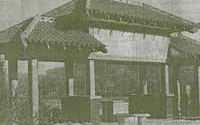
over the bridge and entered the Chinese Pavilion. A description from that year reads:
"The Pavilion ramp faces the Jordan River, whose banks are well dotted with bamboo, pines, lotuses, and water lilies. There are weeping willows, mulberries, flowering plums and peaches, as well as many roses, begonias, chrysanthemums and other flowers. Here also are rare, imported magnolia trees and citrus shrubs, gifts from the Chinese Freemasons president from San Francisco, California.
The magnolia has long been an emblem of peace in China and now being planted in our Peace Garden, the donors trust they will ever remind Americans of the friendship of Chinese loyal to the Republicans cause.
Indeed, during the mayor's remarks that afternoon, he lauded the “truly patriotic” Chinese American community who had done so much "unselfishly for the cause of democracy and toward building better communities."
William Louie, Architecture student from the University of Utah, was the designer of the garden. In true high-minded fashion, the entrance to the thirty-foot gateway of wood and concrete with Chinese style roof tiling was graced with a wooden sign engraved in Chinese with the words “Peace Garden” in the calligraphic hand of Dr. Wellington Koo, the former Chinese Ambassador to the United States. A couplet on either side of the gate read:
China and the West harmonious live beneath auspicious clouds
Joyous emanations permeate the International Peace Garden
In the Original plan as presented to the Peace Gardens Committee in 1950, a massive pair of lion dogs would stand at the
entrance gate and a rockery representing mountains and the scholarly characteristics were to be
added. At the dedication donors were acknowledged and letters of congratulations were read in
English and Chinese. Mrs. Widtsoe and Reverend Robinson gave prayers, Mrs. Wiesley, Mayor Glade
and John Lach’s speeches illustrated the history to date of the Peace Garden project. Alfred Mong
Chairman of the Chinese Garden Committee presided. Following the ceremonies, as attendees ate
delicious sandwiches with ham and turkey stuffing, they must have imagined how far the peace
gardens ideal had come and what a paradise it would be in the forthcoming years.
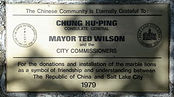
Soon the Parks department added a drinking fountain, and several benches were placed in the garden and a stone table and benches were placed in the pavilion adding to a leisurely atmosphere. Twenty-eight years later, the two stone foo dogs were placed at the entrance gate, a gift from the Chinese Cultural Center, and received by Mayor Ted Wilson.
The Chinese Garden today and the “Plum Pavilion” is still prominent as one enters the garden. The dramatic welcome gate also remains and the monumental stone lion dogs welcome visitors. The cement bridge with its distinct period metal railing still spans the fishpond, however, the wooden structures have suffered damage, (see photo gallery) and some of the tile on the roofs are broken.
The terrazzo stone table and chairs have been chipped lending an unkempt feeling to this
wonderful manifestation of the Chinese American presence in Utah. The garden is replete with
many flowers in the summer, but local varieties predominate. The magnolias, peonies, and citrus
described in old accounts are no longer to be found. The fishpond, like other ponds at the International Peace garden is dry and cracked which is particularly inauspicious for a Chinese garden where water is the life force. The garden is in desperate need of refurbishment. The Peace Gardens International Academy feels that this garden must be protected as one of Salt Lake’s landmarks for its historical and international significance and for its unique architecture showing a 1950’s modern approach to the concept of a traditional Chinese scholar’s garden.